State of Arabic and RTL Websites in 2026: A 220-Site Study
Original measurements reveal where ranked Arabic-region websites succeed—and where HTML direction, logical CSS, accessibility, and search markup still fall short.
This analysis is based on the author's reproducible collector and anonymized 220-site dataset. Every percentage labeled measured is calculated from the published snapshot.
Measured across 220 ranked Arabic-region homepages, 75% declared an Arabic language, 63% set root RTL direction, and 60% did both. Only 5% were dominated by logical CSS properties, while 59% loaded an Arabic web font, 55% published a canonical URL, and image alt-text coverage reached 56%.
Executive summary: the Arabic web is RTL-aware, but not RTL-complete
The 2026 State of Arabic and RTL Websites study measures how production homepages implement Arabic—not whether guidance exists. The sample contains 220 anonymized, ranked Arabic-region ccTLD homepages with at least 200 visible Arabic-script characters in the initial HTML response.
The central finding is a gap between basic awareness and complete implementation. 188 sites (85%) exposed some RTL signal, yet only 131 sites (60%) combined an Arabic language declaration with root `dir="rtl"`. A page can look right-to-left while still withholding essential language or direction metadata from browsers, assistive technology, and search systems.
Key measured findings
| Indicator | Measured count | Measured rate |
|---|---|---|
| Arabic language declared | 166 of 220 | 75% |
Root dir="rtl" | 138 of 220 | 63% |
| Complete Arabic + RTL root | 131 of 220 | 60% |
| Any RTL signal in initial HTML | 188 of 220 | 85% |
| Logical CSS dominant | 11 of 220 | 5% |
| Arabic web font loaded | 129 of 220 | 59% |
| Canonical URL published | 121 of 220 | 55% |
| Meta description published | 152 of 220 | 69% |
| JSON-LD published | 76 of 220 | 35% |
These are measured sample rates, not estimates for the entire Arabic web. The country-stratified collector limits dominance by any one ccTLD, but it is not a population survey and does not execute client-side JavaScript.
Arabic language and RTL direction: 40% missed the complete root pattern
The strongest implementation baseline is explicit and short: <html lang="ar" dir="rtl">. The language attribute identifies the document language; the direction attribute establishes the base direction. They solve different problems, as the W3C language guidance and W3C direction guidance explain.
In this sample, 166 sites (75%) declared an Arabic language, while 138 (63%) set `dir="rtl"` on the root element. Only 131 (60%) did both, leaving 89 pages without the complete root pattern. Seven pages set root RTL without a recognized Arabic language declaration, and 35 declared Arabic without setting root RTL.
That distinction matters because visual appearance alone does not confirm a correct document contract. CSS can force text alignment or layout direction deep in the tree, but the root attributes give browsers and assistive technologies a reliable default before component-level overrides are applied.
For implementation examples, see lang="ar" vs dir="rtl" and test a public page with the RTL Website Checker.
CSS direction remains the largest engineering gap
Only 11 of 220 sites (5%) used more logical directional properties than physical ones in the CSS analyzed. By contrast, 203 sites (92%) were dominated by physical properties such as margin-left, right, and text-align: left.
This is not proof that 92% of layouts are visually broken. Physical CSS can be paired with RTL overrides. It does show that most sampled implementations retain a direction-specific maintenance burden: every physical left/right decision may require a mirrored rule, separate RTL stylesheet, or direction selector.
The MDN CSS logical properties reference documents the direction-aware alternatives. Replacing margin-left with margin-inline-start, right with inset-inline-end, and text-align: left with text-align: start lets the same rule adapt to document direction.
Practical migration order
- Replace physical margins and padding in shared components.
- Convert positioned UI to
inset-inline-startandinset-inline-end. - Replace directional text alignment with
startandend. - Keep explicit physical values only where the physical side is intentional.
- Regression-test mixed Arabic/Latin content at every supported breakpoint.
Arabic web fonts are common, but loading a font is not the finish line
The collector detected deliberate Arabic-supporting web-font loading on 129 of 220 homepages (59%). That suggests typography is a visible product concern for a majority of the measured sites.
Font presence does not establish font performance. The initial crawl records @font-face, Arabic Unicode ranges, and known Arabic family names, but it does not treat a repository file size as a browser transfer measurement. Production cost depends on WOFF2 compression, Unicode subsetting, selected weights, variable axes, caching, and fallback behavior.
Teams choosing a font should compare the exact production assets rather than selecting by popularity. The Arabic font performance and demand dataset separates upstream repository measurements from npm download proxies and explains when Noto Sans Arabic, Noto Naskh Arabic, Cairo, Tajawal, and other families fit different interface needs.
Accessibility and Arabic SEO signals remain uneven
Across 12,864 images, the crawler found non-empty alt text on 7,180, producing 56% measured image alt-text coverage. This metric does not judge whether the text is accurate or useful; it only measures presence. Actual meaningful coverage can therefore be lower, but not inferred from this dataset.
Search markup was similarly uneven. 152 sites (69%) published a meta description, 136 (62%) exposed Open Graph metadata, 121 (55%) included a canonical link, and 76 (35%) published JSON-LD. Each signal solves a different discovery problem, so one should not be used as a proxy for another.
Mixed-direction isolation was especially rare in the initial HTML: no page used a <bdi> element and only 3 sites (1%) exposed dir="auto". This does not prove that every other page mishandles mixed Arabic and Latin content, but it shows that explicit, semantically visible isolation techniques were uncommon in the measured responses.
Use the downloadable RTL implementation checklist to review language, direction, logical CSS, mixed-direction content, typography, forms, accessibility, and canonical markup as one implementation system.
Country comparisons reveal variation—and sample-size limits
The dataset publishes country reports only when the current sample includes at least 10 qualifying sites. This produces 11 indexable country reports. Rates are useful for describing the measured ccTLD samples, but small differences should not be interpreted as national rankings.
| Country sample | Sites | Complete Arabic + RTL root |
|---|---|---|
| Bahrain | 11 | 82% |
| Algeria | 13 | 77% |
| Saudi Arabia | 22 | 73% |
| Egypt | 10 | 70% |
| Oman | 14 | 57% |
| Iraq | 25 | 56% |
| Jordan | 18 | 56% |
| Syria | 13 | 54% |
| Lebanon | 17 | 47% |
| Kuwait | 13 | 46% |
| Palestine | 16 | 38% |
Bahrain led this particular publishable sample at 82%, while Palestine measured 38%. Those figures should be read beside their sample sizes and collection rules, not generalized to every site or organization in either country.
Explore the individual reports from the country comparison table, where each page compares eight technical indicators with the full 220-site sample.
Framework fingerprints: 56% could not be confidently identified
Framework and CMS detection used generator metadata plus recognizable HTML, asset, and cookie signatures. It is a measured heuristic, not authoritative software inventory.
The collector classified 123 sites (56%) as custom or unidentified. WordPress accounted for 44 sites (20%), Next.js for 23 (10%), Drupal for 13 (6%), Laravel for 10 (5%), Shopify for 4 (2%), and Joomla for 3 (1%).
The large unidentified group is important: a missing framework signature does not mean a site has no framework, and a detected signature does not establish version, configuration quality, or security. The useful conclusion is narrower—no single identifiable platform dominates this ranked Arabic ccTLD sample.
What Arabic website teams should prioritize in 2026
The findings point to a practical sequence that reduces risk without requiring a redesign.
- Fix the document contract: set an accurate Arabic language tag and root RTL direction in server-rendered HTML.
- Reduce CSS duplication: migrate shared components from physical to logical properties.
- Test mixed-direction strings: include prices, phone numbers, product codes, URLs, and Latin brand names.
- Control Arabic typography: ship only required font files and weights, with explicit fallbacks.
- Close baseline accessibility gaps: audit every meaningful image for useful Arabic alt text.
- Publish search essentials: verify titles, descriptions, canonical links, and appropriate structured data.
- Measure the delivered response: do not assume hydration will repair incomplete initial markup for every consumer.
The fastest starting point is the RTL Website Checker, which compares a public page with the same benchmark. Teams can then use the focused RTL preview, Arabic form validation, and Arabic text normalizer for specific implementation work.
Methodology and evidence boundaries
The collector starts with the Tranco top-one-million list, filters candidates to 22 Arabic-region country-code top-level domains, and interleaves ranked candidates by ccTLD. A soft country cap prevents one large ccTLD from dominating the final sample.
A homepage qualifies when HTTPS returns HTML and the visible initial response contains at least 200 Arabic-script characters. The collector measures server-returned HTML, inline CSS, and up to two linked stylesheets. It does not execute JavaScript, inspect internal pages, judge visual correctness, or claim accessibility conformance.
Hostnames are replaced with truncated SHA-256 identifiers. Rank and ccTLD remain available for aggregate analysis. The current version 3 snapshot was collected on 24 July 2026 after 1,032 candidate attempts produced 220 qualifying homepages.
The earlier version 2 snapshot remains public but is excluded from trend calculations because sampling changed. The methodology-safe trend page will report percentage-point changes only after another compatible version 3 collection is reviewed and published.
Conclusion: measure the Arabic web as an implementation system
The state of Arabic and RTL websites in 2026 is neither “solved” nor uniformly broken. Most measured pages expose some RTL awareness, but only 60% publish the complete Arabic-language and root-direction pattern. Logical CSS adoption is the clearest engineering opportunity, while accessibility and search signals show substantial room for improvement.
The value of this benchmark is its repeatability. Future compatible snapshots can distinguish real movement from anecdote, and country reports can expose where further targeted research is justified.
Download the 2026 PDF research report, cite the live dataset, or embed an attributed chart in your own coverage.
Shareable research graphics
Download these publication-ready PNGs or embed them in an article. Keep the supplied attribution visible and preserve the sample denominator when discussing a finding.
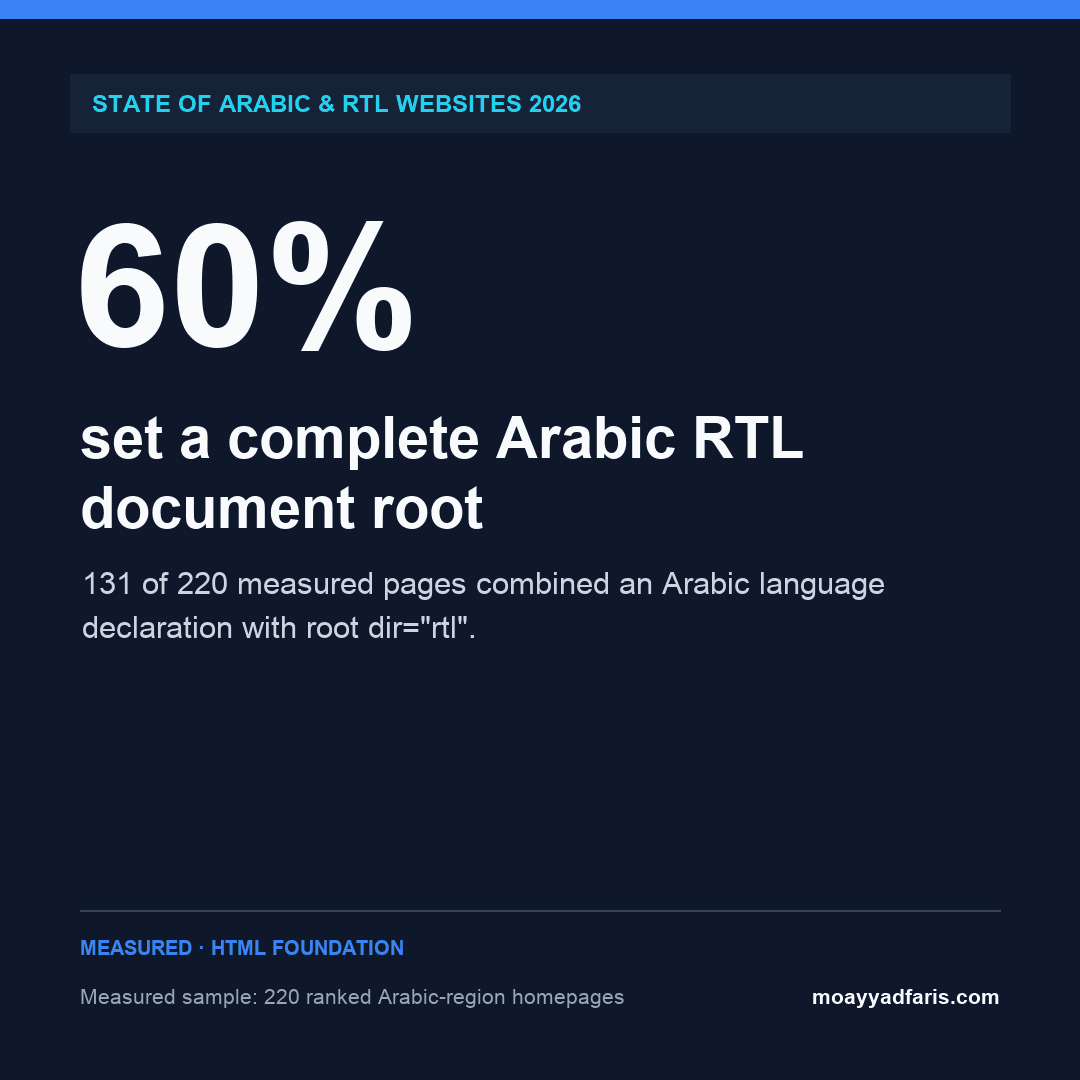
Complete Arabic RTL document root
Evidence: Arabic language and RTL direction →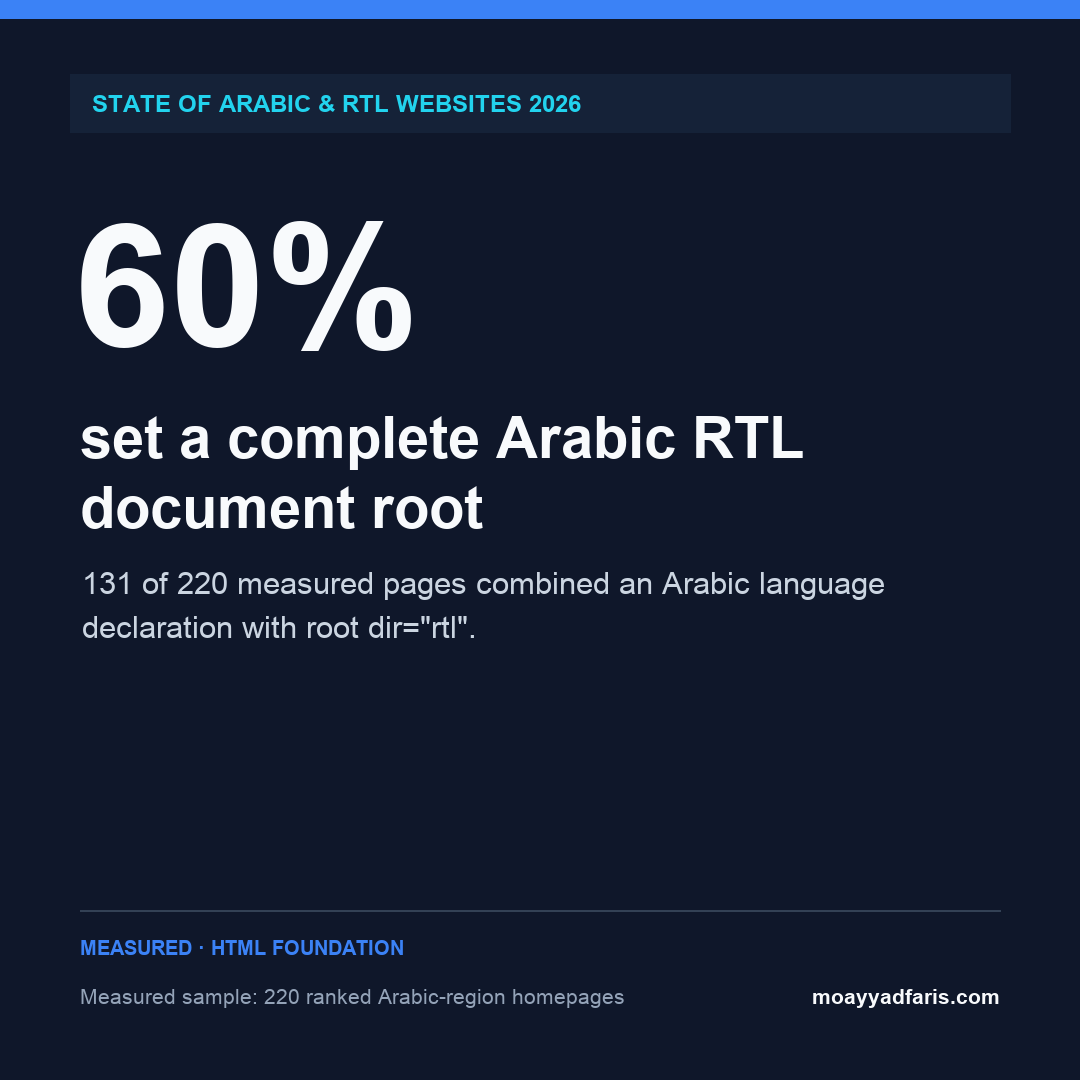
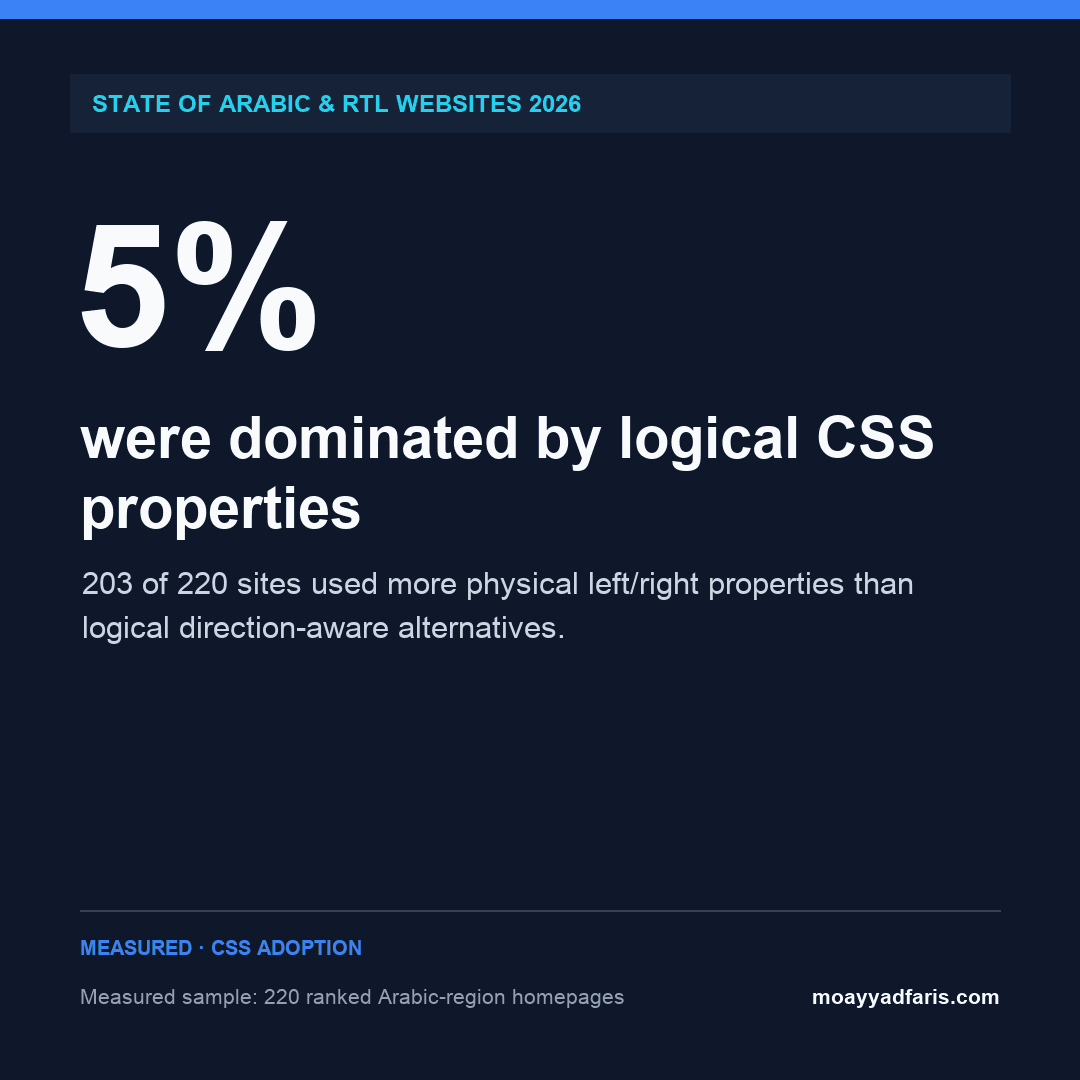
Logical CSS property adoption
Evidence: CSS direction →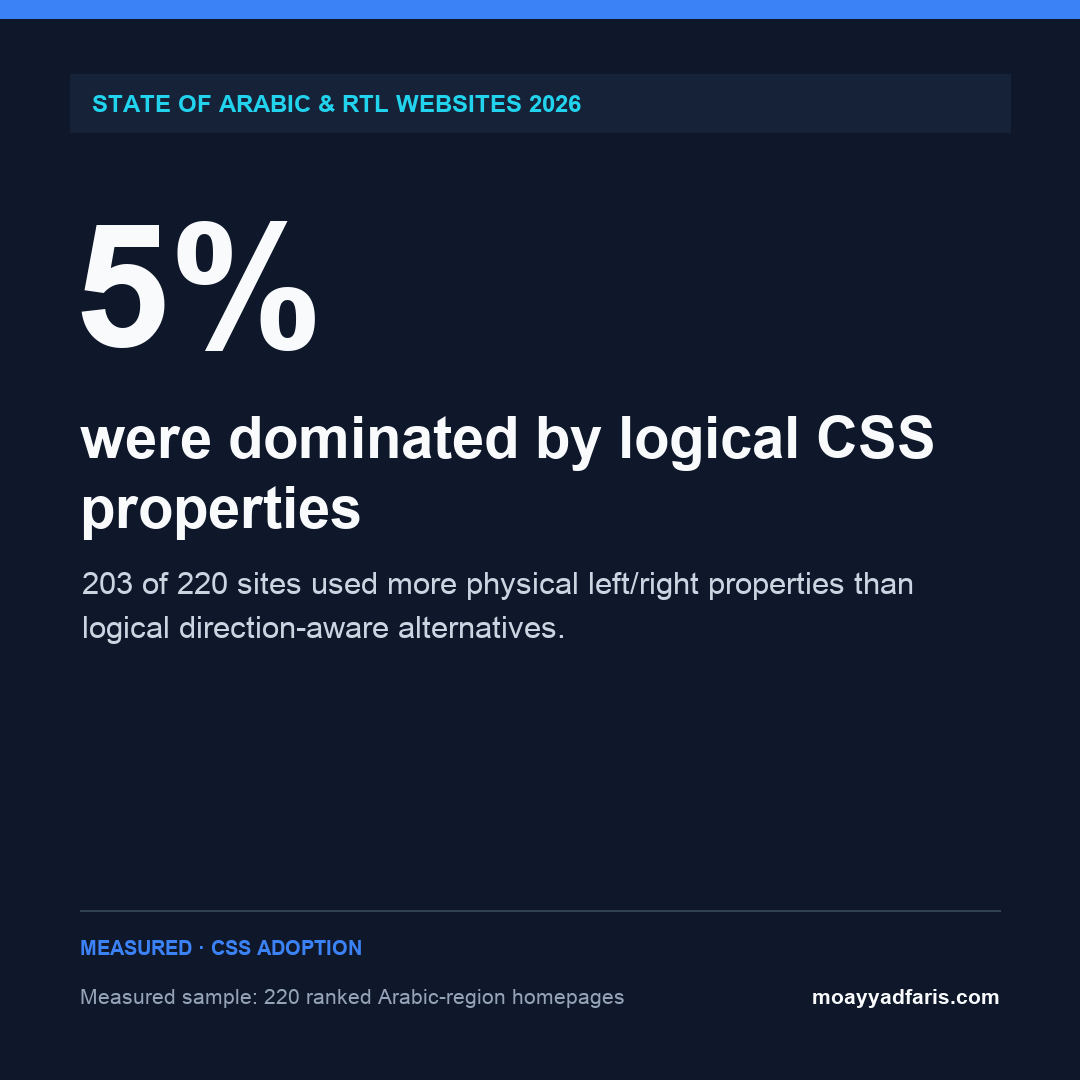
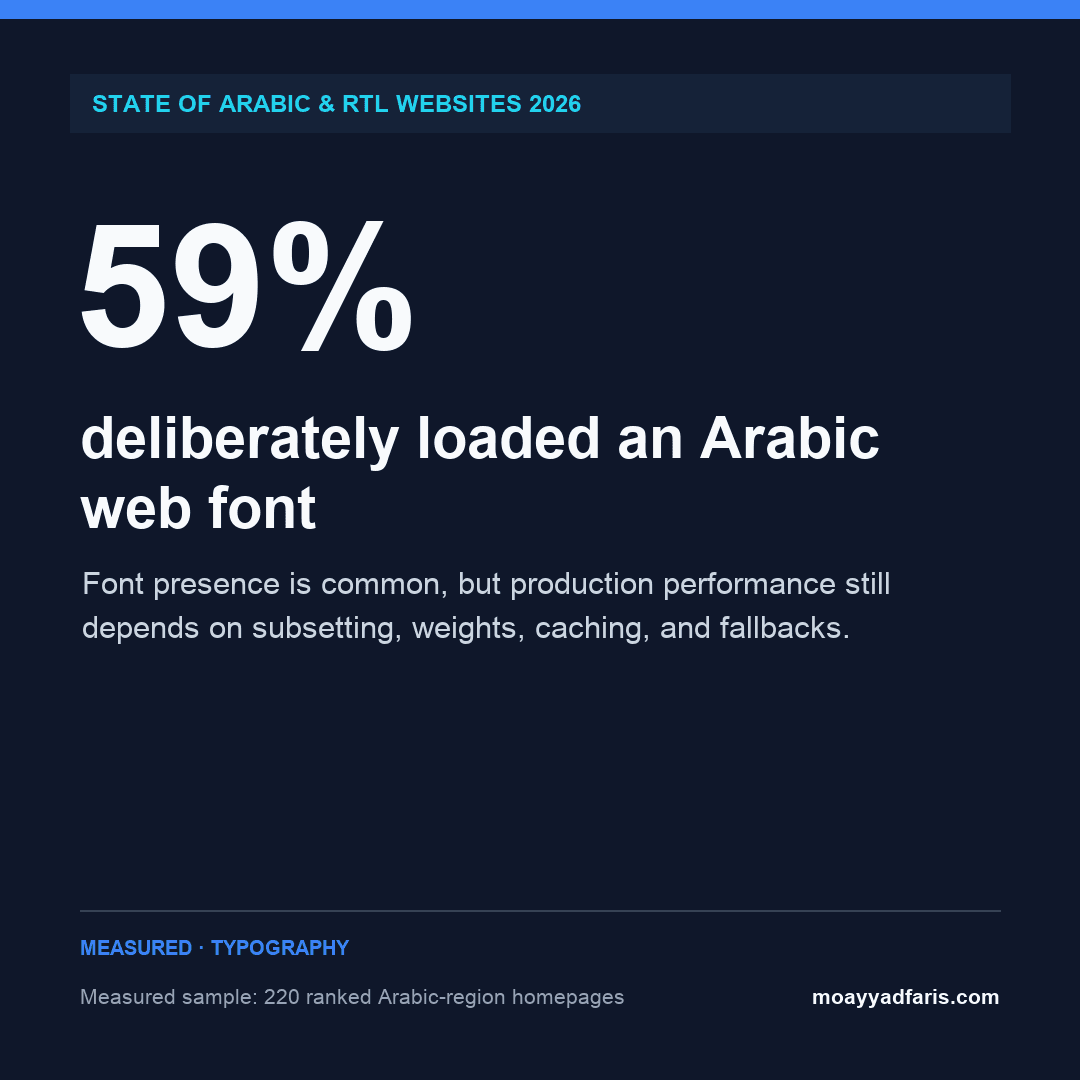
Arabic web font loading
Evidence: Arabic typography →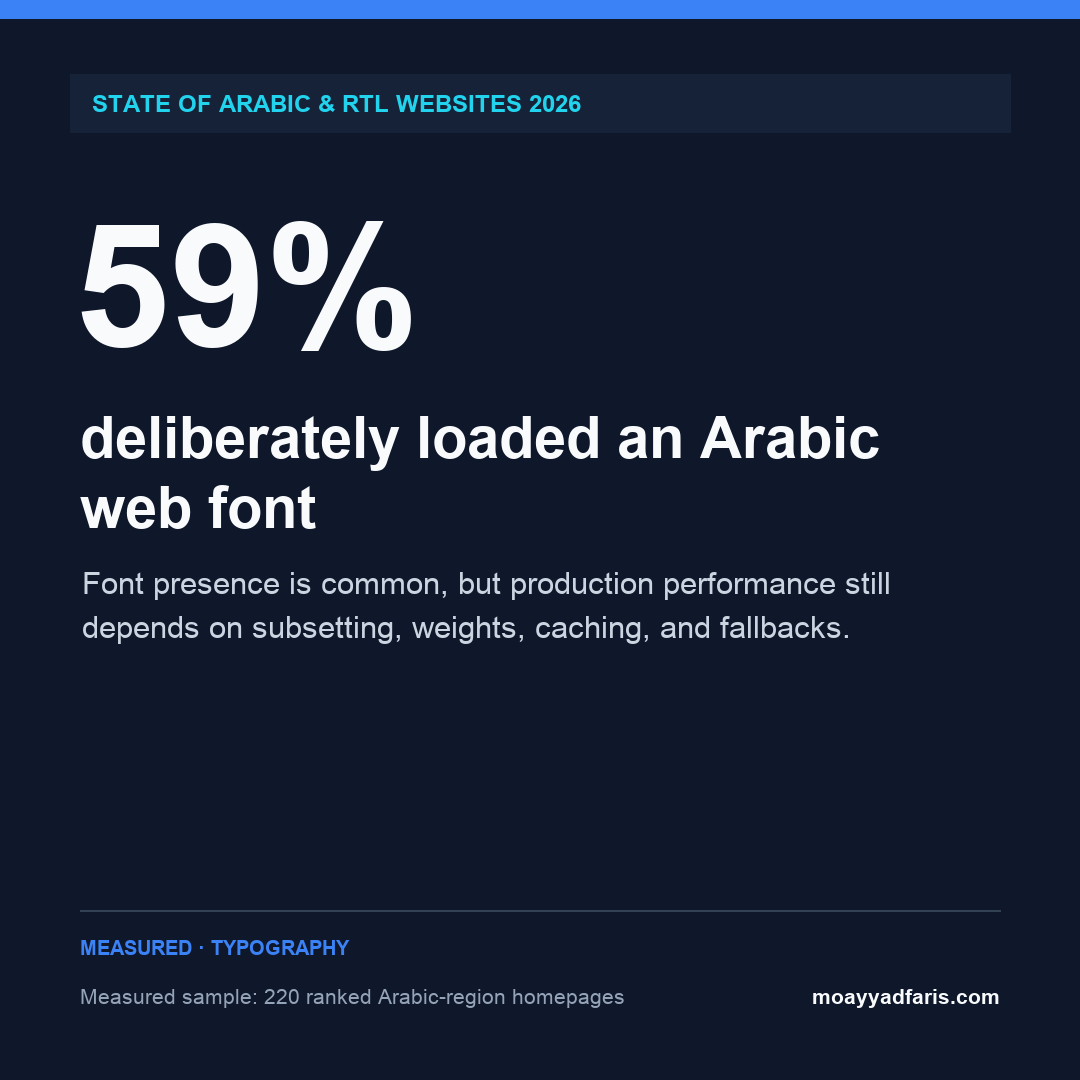
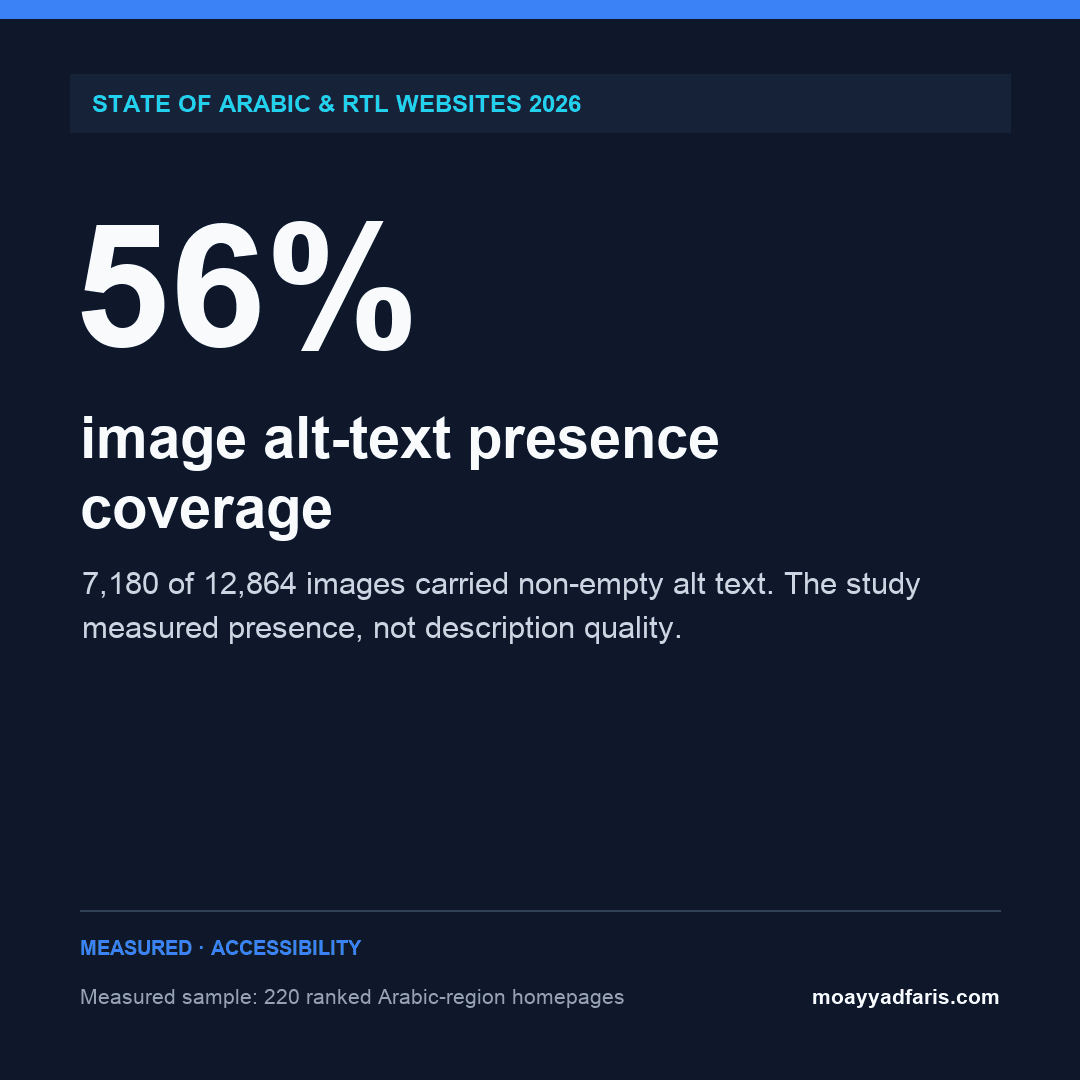
Image alt-text presence
Evidence: Accessibility and Arabic SEO →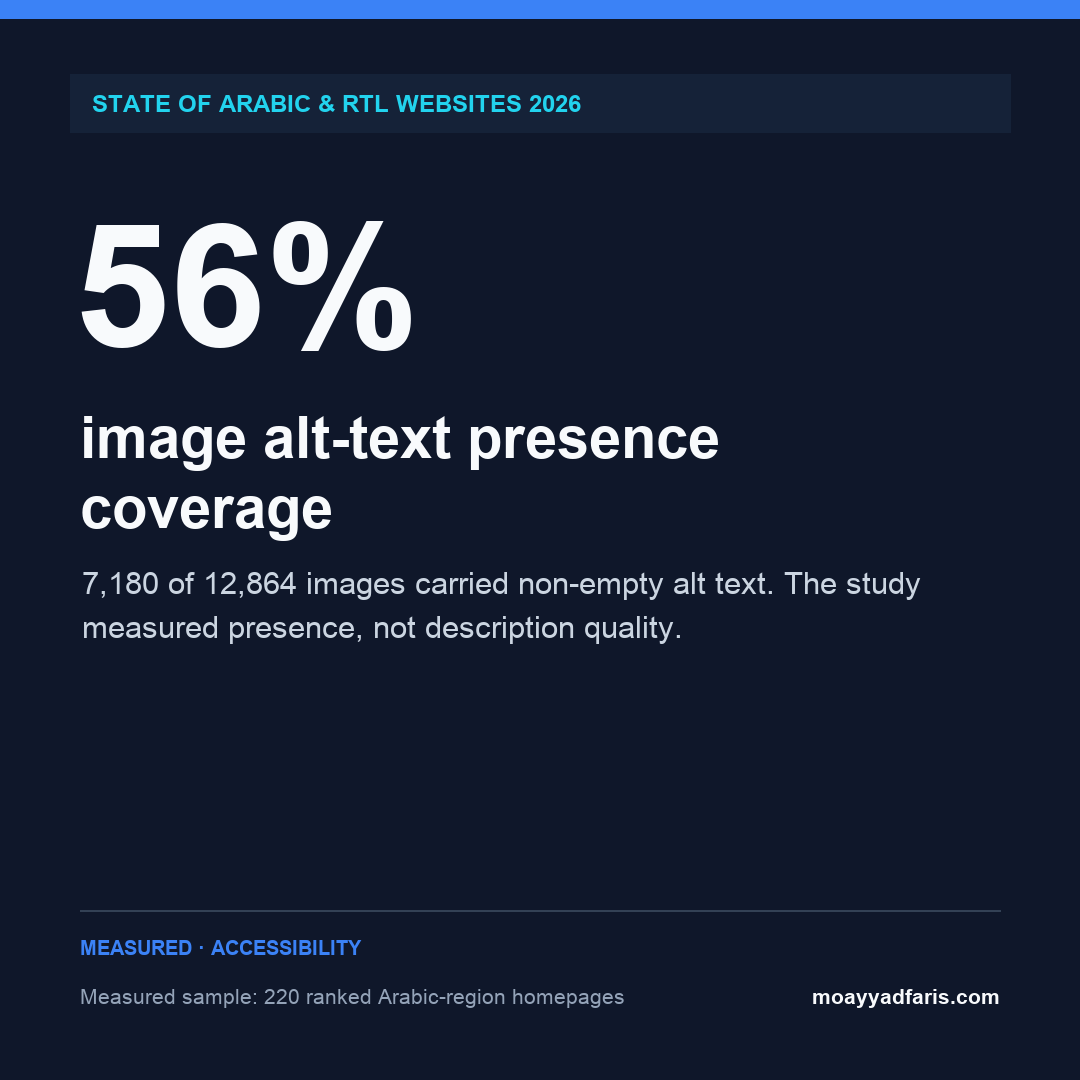
Frequently Asked Questions
How many Arabic websites correctly set both lang and dir attributes?
In this measured 220-site sample, 131 homepages (60%) set both a recognized Arabic language value and dir="rtl" on the HTML element. The result describes ranked Arabic-region ccTLD homepages with substantial Arabic content; it is not an estimate for every Arabic website.
How common are CSS logical properties on Arabic websites?
Only 11 of 220 measured sites (5%) used more logical directional CSS properties than physical ones in the analyzed styles. Another 203 sites (92%) were dominated by physical left/right properties. This measures property usage, not whether each page was visually correct.
Which country had the highest RTL implementation rate?
Among country samples with at least 10 qualifying sites, Bahrain measured the highest complete Arabic-language and root-RTL rate at 82% (9 of 11 sites). The samples are small and describe ranked ccTLD homepages, so the result should not be generalized into a national league table.
Can I reuse the charts and statistics?
Yes. The embed page provides responsive overview, country, and trend charts with source attribution included. Statistics can be cited with a link to the live dataset and collection date. The downloadable PDF provides a stable citation-ready edition of the July 2026 findings.